Daily life in Amalfi during the 11th century
An evidence-led look at a compact Tyrrhenian port where coast and upland, property and labor, churches, mills, and long-distance connections shaped unequal daily lives.
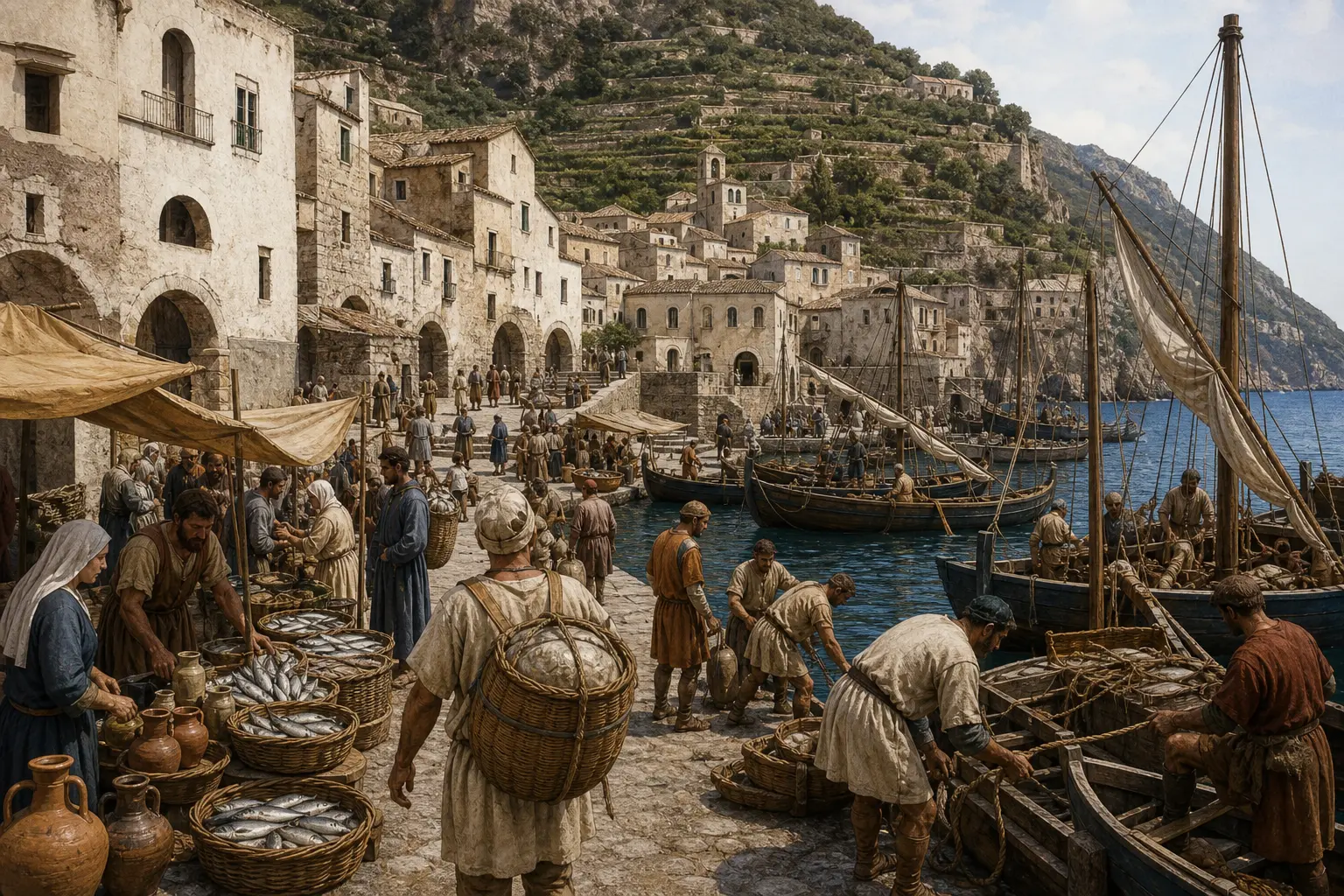
Amalfi in the 11th century was both a compact port and the chief town of a duchy that included coastal settlements such as Atrani and inland communities such as Scala. Steep slopes, short valleys, and restricted access by land made the relationship between coast and upland unusually important. Amalfitans are documented in Constantinople, Egypt, and the Holy Land, but overseas merchants were only one part of the population. Local charters are at least as concerned with land, houses, vines, chestnut groves, mills, churches, inheritance, and tenancy as they are with distant commerce.
The century was not politically uniform. Amalfi began it under its own dukes, experienced intervention by the Lombard princes of Salerno, and submitted to the Norman Robert Guiscard in 1073. Local institutions and families nevertheless continued to operate, and the city briefly reasserted independence under Marinus Sebastos in 1096. It is therefore misleading either to describe all 11th-century life as that of an unchanging “maritime republic” or to treat 1073 as an immediate collapse of Amalfitan society.
Evidence and Its Limits
Daily life has to be reconstructed indirectly. More than 1,000 edited documents or fragments survive for the duchy across the years 800-1250, but most are legal charters: sales, leases, wills, donations, and disputes preserved disproportionately in church archives. They can identify property, crops, kin, legal status, absences on business, and the people who witnessed transactions; they rarely record an ordinary meal, room arrangement, or working day. Standing churches, the cathedral's imported metal door, and other objects add material evidence, while outside writers describe Amalfitan wealth and travel. Those sources tend to show literate property-holders, institutions, and exceptional merchants more clearly than laborers, children, servants, or the poor. The account below therefore distinguishes documented local features from cautious reconstruction.
Housing and Living Spaces
Housing followed Amalfi's constricted terrain. The town occupied the lower valley and harbor edge, while paths and stairs connected it to neighboring and higher settlements. Close-packed masonry buildings are consistent with the surviving urban fabric, but later rebuilding and the destructive storm of 1343 make it unsafe to treat the modern streetscape as an untouched 11th-century plan. The duchy also cannot be reduced to its waterfront: documents locate property at different altitudes and show continuing exchange between the coastal town and its inland territory.
A charter of 970, just before this page's period, records a house in plano, near the harbor, with two shops. It is valuable evidence that urban property could combine domestic real estate and commercial premises, although it does not reveal who slept in which room or how a poorer dwelling was furnished. In 1080 Robert Guiscard granted a fondaco in Amalfi to Montecassino. This was a revenue-producing commercial building associated with the lodging or storage needs of traders, not evidence that every household had a warehouse. Differences in property ownership, rent, and access to storage would have shaped how safely a family could keep grain, cloth, documents, and work materials.
Water tied domestic routines to the landscape. Charters treat whole and divided shares in watermills as valuable property, showing that streams were managed economic resources rather than merely picturesque features. Milling grain, moving produce between upland plots and the coast, and reaching churches or markets all required labor along steep routes. The evidence does not support a precise inventory of public fountains, balconies, or household drains for this century. It does support a town in which access to land, water, mills, and routes varied by location and ownership, and in which domestic life was closely connected to work outside the doorway.
Food and Daily Meals
The secure local evidence concerns production and property more often than recipes. Charters record grain, vineyards, chestnut land, and valuable mills; one sale in 1062 involved chestnut groves. These records show that the peninsula produced food and that cultivation extended beyond the narrow coastal strip. They also qualify the later claim that Amalfitans simply “did not sow or reap”: a description by Benjamin of Tudela belongs to the 12th century and cannot stand for everyone in the duchy a century earlier.
Bread or grain-based dishes, wine, chestnuts, garden produce, and fish are reasonable elements in a reconstruction, but the evidence does not establish a standard Amalfitan menu or the frequency with which households ate meat, cheese, imported spices, or particular legumes. The sea offered fish and maritime traffic could bring grain and other supplies, while Christian fasts affected demand for foods other than meat. Access still depended on wealth, season, storage, and a household's ties to cultivated land or the market. A landholder receiving produce and a tenant surrendering part of a crop did not experience the same food security.
Processing mattered as much as supply. Grain had to reach a mill and then be baked; chestnuts and grapes required seasonal gathering and preparation; water and fuel had to be carried or obtained. Mill ownership recorded in charters indicates control over an essential stage between harvest and food, but it does not identify the laborers who performed every task. Women, servants, dependents, and children are likely to be undercounted in documents written to secure property rights. For that reason, the surviving evidence supports labor-intensive and unequal provisioning, not a precise timetable of meals or a complete list of kitchen utensils.
Work and Labor
Maritime work was important, but the surviving evidence is strongest for a relatively small group of mobile and wealthy people. Eleventh-century Amalfitans maintained connections with Constantinople and increasingly frequented Fatimid Egypt; members of the Comitemauroni family also appear in eastern religious and charitable foundations. These contacts required sailors, provisioning, cargo handling, storage, and credit, yet records of prominent merchants cannot supply a census of port occupations. Even the scale of Amalfi's early trade has been debated because celebratory outside accounts and local charters emphasize different things.
Local work joined cultivation, milling, property management, transport, craft, and service. Tenants and peasant cultivators appear in the documents, as do people in unfree or tied relationships. Vines and chestnuts linked seasonal field work to storage and exchange, while watermills could be divided into shares and traded as valuable assets. The 1080 fondaco shows that commercial premises continued to matter under Norman authority. The famous paper industry, however, belongs to later medieval Amalfi; the existence of streams and mills in the 11th century does not demonstrate local paper manufacture then.
Notaries and scribes are unusually visible because written acts protected sales, leases, inheritances, dowries, gifts, and claims by kin. A large land purchase in 1060 was valued in gold tarì, and documents of the 1060s and 1080s refer to Amalfitan currency. Such evidence shows a monetized world for substantial transactions, not that every loaf or day's work was paid for in gold. Labor also followed different calendars: voyages depended on weather and political conditions, cultivation on harvest seasons, and church observance on fasts and feasts. The records preserve these activities unevenly and usually name people when property or legal responsibility was at stake.
Social Structure
Amalfitan society was unequal, but it was not arranged as a simple ladder of merchant families above undifferentiated workers. Charters identify counts, holders of Byzantine-derived titles, judges, notaries, and the boni homines or “good men” who witnessed and helped settle affairs. At the other end of the record are enslaved or semi-free people, children transferred into others' care, and tied servants. Between them were cultivators and tenants, some of whom could use access to land as a route to greater security. Legal status, property, gender, age, kin support, and access to witnesses all affected a person's choices.
Households and kin groups organized property across generations. Dowries, inheritance, wills, and gifts to churches were not merely ceremonial arrangements: they decided who could use land and income. Female landownership becomes increasingly visible in the Amalfitan evidence, although a woman's power to act depended on her particular family and legal circumstances. Men dominate many formal acts because notaries recorded transactions in which recognized owners, representatives, and witnesses had to establish their rights. This documentary imbalance is not proof that women, servants, or children were absent from production and household management.
Churches and monasteries were landholders, archive keepers, and centers of commemoration as well as places of worship. Charters record pious gifts and privately founded churches; by the end of the century the peninsula had small episcopal sees at Amalfi, Minori, Scala, and, from 1087, Ravello. That new see had a political dimension, showing how religious geography could express local rivalry and status. Contacts with Greek-speaking Byzantium, Muslim-ruled Egypt, and the Norman world were real, but the documents do not justify imagining an evenly mixed or tolerant population. Those encounters were shaped by religion, wealth, legal protection, and the exceptional mobility of particular families.
Tools and Technology
Documents reveal systems more securely than complete tool kits. Watermills converted stream flow into processing power, while boats and pack transport connected the harbor to settlements at different heights. Notarial work required trained writers and durable records; the survival of charters shows a professional documentary culture with roots in Byzantine practice. Ships necessarily used hulls, rigging, anchors, and containers, but no known 11th-century Amalfitan inventory supports the long, precise equipment list sometimes repeated in modern descriptions.
The cathedral door offers unusually concrete material evidence. Made in Constantinople around 1060 and associated with the patron Pantaleone of Amalfi, it consists of copper-alloy plates fixed to a wooden core, with inlaid decoration; such modular construction made large doors transportable. The object demonstrates access to specialized Byzantine workmanship, shipping capacity, and the resources of an exceptional patron. It should not be read as evidence that ordinary Amalfitan metalworkers used the same techniques.
Clothing and Materials
Outside accounts associated Amalfi with gold and luxury cloth, and elite patrons demonstrably moved costly objects between Constantinople and Italy. These sources illuminate display and long-distance networks better than ordinary wardrobes. Wool, linen, leather, and some silk were available in southern Italy, but the Amalfitan charters used here do not support assigning a fixed set of tunics, hoods, veils, aprons, and hose to every resident. Occupation, wealth, gender, season, and whether a person worked at sea or on cultivated slopes would have mattered.
Cloth was labor-intensive and valuable, so cleaning, mending, alteration, and reuse are more defensible general expectations than claims about bright dyes or imported silk in typical homes. Fine textiles should be associated chiefly with households able to participate in elite gift-giving and overseas exchange. For poorer and unfree people, durability and access may have mattered more than fashion, but their garments rarely entered property records in enough detail to reconstruct them. This evidential silence is worth retaining: the city's reputation for eastern luxuries should not be allowed to dress its whole population as merchants.
Daily life in 11th-century Amalfi joined a difficult coastal landscape to a wide Mediterranean network, but not everyone shared equally in either land or trade. Charters bring tenants, women landholders, unfree people, notaries, clergy, and powerful families into view through property and legal acts; mills, churches, commercial buildings, currency, and the cathedral door supply firmer material anchors. Much of the repetitive labor behind food, clothing, transport, and care remains unnamed. Amalfi's history is therefore best understood through the interaction of coast and upland, household and institution, documented wealth and less visible work, across a century of political change.
Related pages
- Daily life in Palermo during Norman Sicily
- Daily life in Genoa during the 13th century
- Daily life in Venice during the 1300s
- Daily life in Hormuz during the 14th-15th centuries
References
- Skinner, Patricia. Medieval Amalfi and Its Diaspora, 800-1250. Oxford University Press, 2013. https://doi.org/10.1093/acprof:oso/9780199646272.001.0001
- Citarella, Armand O. “Patterns in Medieval Trade: The Commerce of Amalfi Before the Crusades.” The Journal of Economic History 28, no. 4 (1968): 531-555. https://doi.org/10.1017/S0022050700100968
- Constable, Olivia Remie. “Fondacos in Sicily, South Italy, and the Crusader States.” In Housing the Stranger in the Mediterranean World: Lodging, Trade, and Travel in Late Antiquity and the Middle Ages, 201-233. Cambridge University Press, 2004. https://doi.org/10.1017/CBO9780511496264.007
- Buccolieri, Alessandro, Alfredo Castellano, Vito Nicola Iacobellis, Fabio Paladini, and Giovanni Buccolieri. “ED-XRF Analysis of the Mediaeval Copper-Based Door in Monte Sant'Angelo (Southern Italy).” Archaeological and Anthropological Sciences 13 (2021): 95. https://doi.org/10.1007/s12520-021-01336-x