Daily life in Mogadishu during the 13th-14th centuries
A grounded look at an Indian Ocean port where coral houses, mosques, weaving, fishing, markets, caravan goods, and household labor shaped ordinary routines.
Mogadishu in the 13th and 14th centuries was one of the major towns of the Benadir coast, facing the Indian Ocean and linked inland to pastoral, farming, and caravan communities. Travelers described it as large, prosperous, Muslim, and commercially active, but daily life depended on practical routines more than on distant reputation. People carried water, cleaned fish, wove cloth, tended shops, repaired boats, managed household stores, copied contracts, hosted visitors, and coordinated work around prayer times, tides, markets, and monsoon seasons.
Chronology and evidence. This page covers the 13th and 14th centuries, but its evidence does not describe both centuries equally. Ibn Battuta's account concerns the 14th century, particularly his experience as a visitor. The later Benadir weaving traditions mentioned below provide context, not direct evidence of identical medieval practices. Descriptions of ordinary households and work routines include reconstruction; neither the visitor account nor later traditions establish that these arrangements applied throughout both centuries or across all households.
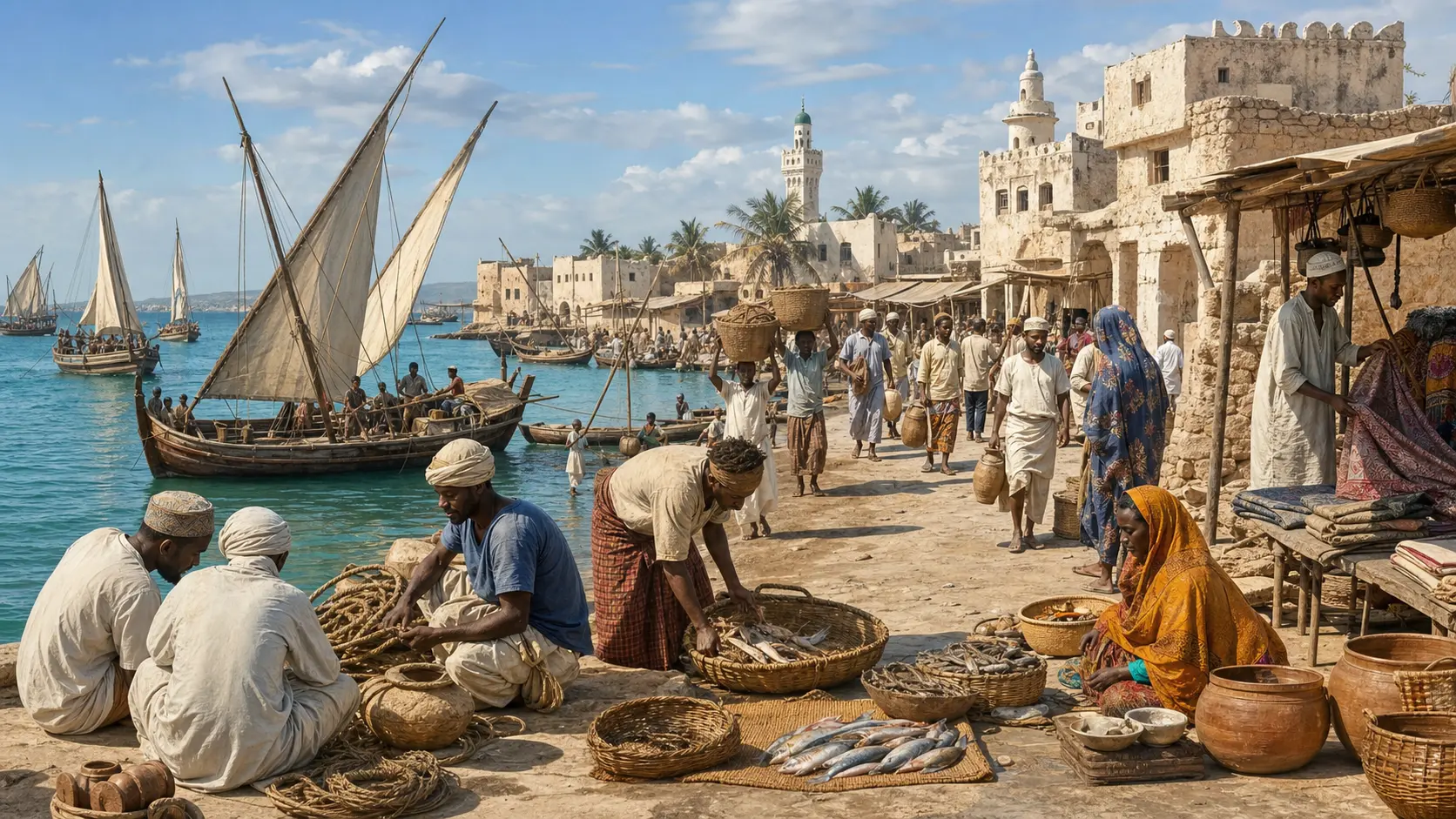
The city belonged to the same maritime world as Aden, Mombasa, and Kilwa Kisiwani, but its everyday texture was local: Benadir craft traditions, mosque communities, coastal foods, and commercial ties that joined the shore to inland herders and farmers. The evidence presented here does not establish the distribution of languages across its neighborhoods.
Housing and Living Spaces
Coral-stone and lime-plastered buildings form part of the city's architectural context, but the references presented here do not establish a typical household plan for the whole 13th–14th-century period. Shaded rooms, domestic storage, and spaces for receiving visitors are plausible features of a coastal merchant household; they should be read as reconstruction rather than as documented arrangements in ordinary homes. Some houses likely combined domestic life with commercial storage, though the extent of this arrangement remains uncertain.
Humbler dwellings made with timber, palm materials, or earth are also possible, but their prevalence and placement beside stone houses are not established here. Mats, baskets, and water jars help illustrate how domestic spaces might have served several purposes. The supplied evidence does not support a fixed arrangement of sleeping rooms, cooking areas, partitions, or furnishings across the city's households.
Water collection, food storage, cleaning, and repairs offer a useful framework for imagining household work. Their organization, including who performed each task, is less certain. Descriptions assigning errands to children, food and textile work to women, or movement between shops and mosques to men should not be treated as established divisions of labor throughout both centuries.
Food and Daily Meals
The sea, coastal markets, and inland farming and pastoral communities provide the setting for understanding Mogadishu's food supply. Fish, grains, and livestock products are broad categories discussed in this account, not a documented menu for every household. The supplied material does not establish how frequently ordinary residents ate particular foods or how access varied across the two centuries.
Preparing meals involved work with food, water, fuel, and storage. Grain processing and fish preservation are plausible parts of a reconstruction, but specific cooking methods, household equipment, and divisions of labor need more direct support. Shared ovens and fixed roles for women, servants, children, or hired workers are not established by the evidence presented here.
The 14th-century traveler Ibn Battuta emphasized the organized reception of visitors in Mogadishu. His account provides evidence about visitor hospitality in that century; it does not establish the everyday meals of ordinary residents or a contrast between standard wealthy and working-family menus. Hospitality should therefore remain distinct from reconstructions of household diet, and should not be projected unchanged into the 13th century.
Work and Labor
Work can be grouped around maritime transport, market exchange, craft production, and household provisioning. Sailing, carrying cargo, storing goods, and selling supplies illustrate the activities associated with a trading port. These examples should not be read as a complete, documented inventory of separate occupations in Mogadishu throughout the 13th and 14th centuries.
Textile work was especially important: medieval accounts connect Mogadishu with fine cloth, while later Benadir traditions preserve the city's importance as a weaving center. The later traditions do not establish the same tools, techniques, or organization of labor for both medieval centuries. Weaving and cloth finishing can be considered alongside boat and building repairs and food preparation, without assuming that each activity occupied a separate workshop or followed a uniform household routine.
Trade connected the city with inland farmers, pastoralists, and caravan communities supplying food and materials. Household management and textile work also belong in this picture, but the evidence presented here does not establish their division by gender or the extent of women's participation in property and credit. References to enslaved and dependent labor likewise do not establish its scale or distribution across domestic service, carrying, crafts, and agriculture; conditions could vary. Prayers, heat, tides, ship arrivals, and monsoon seasons provide a framework for work rhythms rather than a fixed schedule for every worker.
Social Structure
Travelers described Mogadishu as a Muslim commercial city connected to the wider Indian Ocean. Merchants, religious figures, and households able to host visitors feature in this account, but their prominence does not describe the circumstances of all residents. Property, kinship, religious learning, and trade contacts offer a framework for discussing status; their relative importance and the reach of credit arrangements are not established here.
A broader picture includes people engaged in fishing and transport, crafts and building, household service, and learning. These groups should not be treated as a census or a fixed social ladder. The supplied material does not establish typical household membership, common routes of social mobility, or the proportion and circumstances of enslaved residents.
Language, gender, and age require similar care. References to Somali speech and Arabic religious or commercial literacy do not establish uniform language use across the city. Nor does the evidence presented here establish a universal division between men's public work and women's household responsibilities, or fixed roles for older people and children. The detailed arrangements of neighborhood and family life remain less certain than the visitor accounts of trade and hospitality.
Tools and Technology
Tools are best considered by activity. Boats, sails, and ropes belong to maritime transport; hooks and nets illustrate fishing; containers and weighing equipment illustrate cargo handling and exchange. Knowledge of monsoon winds and coastal routes provides the navigational context. These examples are a reconstruction of practical needs, not a verified inventory of equipment used by every worker across both centuries.
On land, the main activities include building with coral stone and lime plaster, preparing and storing food, making cloth, and keeping written records. Masonry tools, cooking and storage vessels, looms and needles, and writing materials illustrate those activities. The supplied content does not establish the precise tool forms, materials, or household distribution, and later weaving traditions should not be used to date a particular medieval toolkit.
Clothing and Materials
Locally made and traded cloth connects clothing to Mogadishu's textile economy. Cotton cloth, wrapped garments, robes, and head coverings are examples used in this reconstruction, not a documented wardrobe shared by all residents. The supplied evidence does not establish fixed styles for men and women or precise differences by occupation, wealth, and occasion throughout both centuries.
Repair, reuse, storage, and gift-giving are plausible ways to consider the household value of textiles. Claims that cloth was routinely pledged for credit, or that particular imported fabrics and ornaments were common, need more direct support. Later Benadir weaving traditions provide context but do not establish the clothing or material possessions of ordinary medieval households.
Daily life in Mogadishu during the 13th and 14th centuries was built from the overlap of household discipline and oceanic exchange. The city was famous to travelers for wealth and trade, but its routines were made by cooks, weavers, fishers, porters, scribes, teachers, builders, servants, and families who kept rooms stocked, boats repaired, wells used, markets supplied, prayers observed, and kinship ties active across a busy coastal town.
Related pages
- Daily life in Aden during the Rasulid period
- Daily life in Mombasa during the Swahili city-state period
- Daily life in Kilwa Kisiwani during the 14th-15th centuries
- Daily life in Hormuz during the 14th-15th centuries
References
- Ibn Battuta. The Travels of Ibn Battuta, A.D. 1325-1354, Volume II. Translated by H. A. R. Gibb. Hakluyt Society, 1962.
- Dunn, R. E. (2005). The Adventures of Ibn Battuta: A Muslim Traveler of the Fourteenth Century. University of California Press.
- Jama, A. D. (1996). The Origins and Development of Mogadishu AD 1000 to 1850: A Study of Urban Growth Along the Benadir Coast of Southern Somalia. Uppsala University.
- Lambourn, E. (1999). The decoration of the Fakhr al-Din Mosque in Mogadishu and other pieces of Gujarati marble carving on the East African coast. Azania: Archaeological Research in Africa.
- Pradines, S. (2022). Historic Mosques in Sub-Saharan Africa: From Timbuktu to Zanzibar. Brill.
- Kusimba, C. M. (1999). The Rise and Fall of Swahili States. AltaMira Press.
- Wikipedia contributors. (n.d.). Fakhr al-Din Mosque. https://en.wikipedia.org/wiki/Fakhr_al-Din_Mosque
- Wikipedia contributors. (n.d.). Arba'a Rukun Mosque. https://en.wikipedia.org/wiki/Arba%27a_Rukun_Mosque