Daily life in Gravettian mammoth bone villages during the late Ice Age
A grounded look at repeated or seasonal Ice Age camps in central and eastern Europe. Here, “villages” describes concentrations of camp remains, not the permanent farming settlements of later periods.
Gravettian mammoth bone villages were not villages in the later farming sense. They were repeated, seasonal, or sometimes semi-settled camps, especially known from the open-air sites of Moravia, Ukraine, and the Russian Plain. Nearby shelters and accumulated remains need not represent simultaneous or year-round occupation. People used mammoth bones, tusks, hides, wood, earth, and stone to organize domestic space, with arrangements varying between sites. These communities belonged to the broader world of Upper Paleolithic Europe, after earlier Aurignacian hunter-gatherers and before some later Magdalenian reindeer hunters. Their daily life combined mobility with repeated return to rich places: slopes below limestone hills, river terraces, animal routes, fuel sources, and social gathering points.
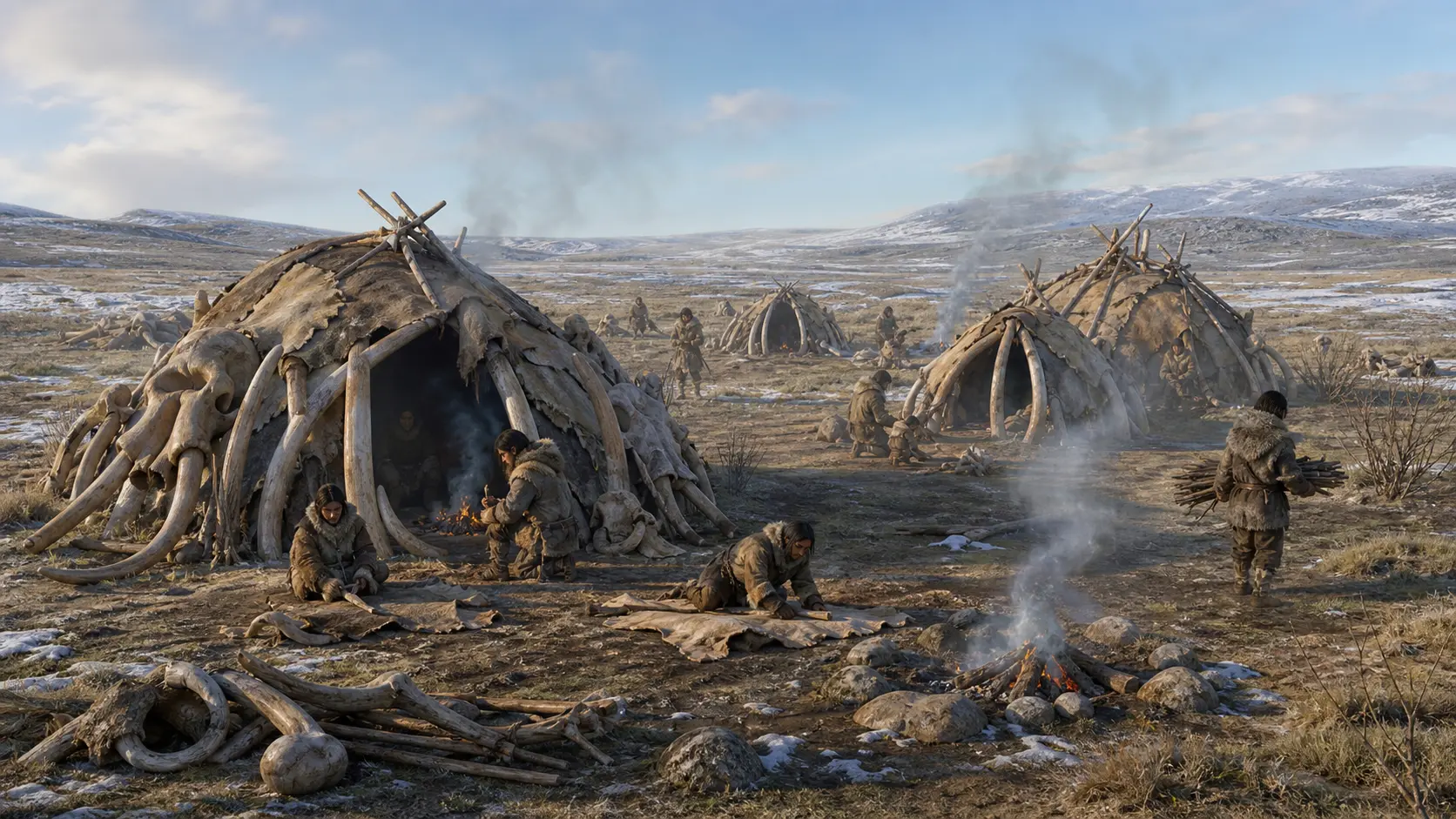
Housing and Living Spaces
Housing in these camps is reconstructed from surviving arrangements of bones, stones, hearths, and floors, alongside less durable materials such as wood and hides. Sites such as Dolni Vestonice, Pavlov, Predmosti, Kostenki, and related eastern European camps should not be treated as examples of one uniform house type. Mammoth bones and tusks could serve as frames, weights, windbreaks, foundations, or boundaries rather than forming whole houses by themselves. Wooden poles, hides, turf, and packed earth may have completed shelters, but their arrangement must be assessed site by site. In some places, shallow floors and stone or bone arrangements help reconstruct possible entrances, hearths, and work zones.
These camps can look village-like because traces of shelters, hearths, pits, refuse areas, and workshops lie near one another. Proximity alone does not establish that they were all in use at once or occupied year-round. A site might be used for a season, abandoned, and revisited when animals, fuel, weather, and social timing made it useful again. Ash, burned bone, flint debris, ochre, ornaments, and food remains record activity, but their accumulation may span repeated visits. Hearths suggest places for warmth, cooking, and work; a detailed scene of people tending children or exchanging information around them remains a reconstruction.
The distribution of remains can suggest areas used for different tasks rather than permanent rooms. Hide working, toolmaking, sleeping on hides or grasses, and keeping heavy bones or tusks are possible uses, with different levels of archaeological visibility. Concentrations of bones, broken tools, and ash may reflect disposal or repeated activity, rather than the layout of one household at one moment. Heavy materials could have been left for a later return. Proposed entrances, hearth positions, and windbreaks can help reconstruct attention to smoke, drafts, and movement, but do not by themselves establish a complete domestic routine. A substantial camp could therefore support repeated occupation while remaining part of a wider seasonal round.
Food and Daily Meals
Potential food resources included mammoth, reindeer, horse, bison, hare, birds, fish in some river settings, and seasonal plants. Mammoth remains are prominent at many sites, but their presence does not establish the composition of daily meals. Animal remains also reflect uses other than food, including skins and raw materials. Reindeer and horse could be important herd resources, while smaller animals offered food or useful skins. Plant foods are less visible archaeologically: roots, seeds, berries, and greens are possible seasonal resources, not a documented menu shared by all the named camps.
A successful hunt could create a period of abundance followed by substantial processing work. Broken bones may help reconstruct marrow extraction, while crushing and heating spongy bone is a possible route to obtaining grease; particular interpretations depend on the remains at each site. Fat would have been valuable alongside lean meat. Drying or smoking meat for later use and roasting or boiling it for consumption are possible practices, but this range should not be read as an established sequence after every kill. Hearths and food remains offer evidence of activity without preserving a complete account of preparation or storage.
Hearths provide a basis for reconstructing cooking and warmth. Roasting over embers, cooking on hot stones, drying meat near a fire, or thawing frozen food are possible uses. Boiling with heated stones in hide, bark, or wooden containers is a further reconstruction, not a container technology established here for every named site. Small household meals and larger sharing after major kills or seasonal gatherings are plausible social arrangements, but the remains do not directly identify meal groups, portions, or rules for feeding children, elders, injured people, and visitors. Sharing may have reduced the risks of uneven hunting success and maintained obligations between groups. Scraps, cracked bones, and ash can indicate disposal, but do not reveal a fixed routine of clearing the hearth after each meal.
Work and Labor
Hunting required tracking, planning, weapon maintenance, knowledge of animal movement, and coordination. After a kill, processing could include removing hides, cutting meat into transportable pieces, opening bones for marrow, and selecting sinew, ivory, or long bone for later use. Mammoth hide and bone, reindeer skin, fox and hare fur, horse hide, antler, teeth, and perhaps bird feathers offered different possibilities; their use varied with availability and site evidence. Animal materials could become shelter covers, garments, bedding, tool blanks, ornaments, bags, straps, patches, or fuel support. This range of possible uses does not mean every part was used at every camp. Large carcasses could require substantial shared labor, although the number of workers and duration are reconstructed.
Camp upkeep probably involved collecting fuel, tending embers, fetching water or snow, cleaning hearths, maintaining shelters, arranging bedding, carrying loads, sorting food, and caring for children. Fuel could include wood, brush, and sometimes bone, especially where woody material was scarce or distant. Hide working could involve scraping, stretching, softening, smoking, cutting, sewing, and later mending, without requiring the same sequence in every case. Sinew, plant fiber, or hide thongs could provide thread and bindings. Shelter covers, winter garments, sleeping robes, bags, and footwear would require skilled labor; worn seams, soles, and other surfaces would create further repair work. Resetting covers, clearing snow or mud, and protecting stored materials from damp are plausible maintenance tasks.
Craft production included stone knapping and work in bone, antler, ivory, and teeth. Fired-clay objects at Dolni Vestonice and fiber impressions in clay at Pavlov provide evidence for particular crafts at those sites. The impressions document fiber working; identifying finished products such as nets, mats, or basketry requires further interpretation. These finds do not establish that every camp practiced the same crafts or that particular households specialized in them. Children may have learned by watching, carrying, sorting, and practicing on discarded fragments. Experienced workers may have gained recognition for tracking, sewing, carving, or remembering routes, but individual reputations cannot be read directly from the craft remains.
Social Structure
Households, kin ties, and wider regional networks offer a possible framework for understanding these camps; their precise organization is not directly preserved. Several hearths might represent families sharing work areas and social space, but need not all belong to one occupation. Membership may have been flexible, with people joining relatives, marriage partners, or allied groups in different seasons. Larger gatherings may have formed when herds, weather, raw materials, or ritual occasions made concentration useful. Such possibilities help explain how contacts beyond an immediate group could matter in thinly populated Ice Age landscapes, without establishing a single social system or form of leadership.
Burials, ornaments, and unusual objects provide evidence that some people received distinctive treatment. Beads, ochre, and differences in burial treatment can inform interpretations of identity and social distinctions, but do not reveal exactly how status was gained. Skill, reliability, generosity, memory, or age may have brought influence: hunters, people skilled in sewing or knapping, ivory carvers, healers, or elders are possible examples, not identified offices. Age, relationships, and social roles are possible explanations for differences in treatment. Neither a rigid class system nor its absence follows automatically from those differences.
Shells, high-quality stone, pigments, ivory objects, and similarities in ornament styles suggest movement of materials, people, and ideas between camps. Exchange and gatherings are possible ways those connections were maintained. Trading, arranging partnerships, sharing hunting information, performing rituals, and renewing obligations are reconstructions of what meetings might have involved. Beads, pendants, decorated clothing, or body pigment could have signaled affiliation or life stage, but their exact meanings are uncertain. Children may have learned about relatives, trusted contacts, and remembered places through these networks. Kin pressure, moving away, and negotiated sharing are possible ways of resolving disputes; the evidence described here does not establish which methods people used.
Tools and Technology
Stone toolkits included blades and bladelets struck from prepared cores and retouched into cutting tools, scrapers, burins, backed pieces, and points. Scrapers could clean hides, burins cut or groove bone and ivory, and sharp flakes serve in butchery. Hafting into wooden, bone, or antler handles with bindings such as sinew, hide strips, or resin could make tools easier to use and allow a damaged edge to be replaced. These functions and arrangements should be assessed against the tools preserved at each site rather than treated as an identical toolkit carried by every group.
Bone and antler points could serve in hunting equipment; awls and needles could pierce materials or make seams, while polishers and smoothers supported hide work. Ivory objects included ornaments, points, and figurines. Large bones or tusks could also help structure shelter space. Fire provided heat and light and could support cooking and drying; proposed uses such as bone-grease extraction require their own evidence. At Dolni Vestonice, fired-clay animal and human figures demonstrate clay firing in a context distinct from farming pottery. They do not establish the use of pottery cooking vessels or show that every camp shared this technology.
Impressions in fired clay from Pavlov indicate fine, regular fiber work, including interlaced forms. Because organic materials rarely survive, these traces offer evidence beyond the durable stone and bone toolkit. Cordage, nets, bags, mats, basketry, and perhaps woven or twined textiles are possible products, but impressions do not identify every finished object or its purpose. Uses such as catching small animals with nets or snares, carrying supplies, lashing shelters, supporting drying racks, or making bedding remain interpretations to assess separately. The Pavlov evidence should not be extended into a complete inventory of fiber technologies for Dolni Vestonice or every other camp.
Clothing and Materials
Clothing offered protection against frost, wind, and damp ground during travel and outdoor work. Hide-working and sewing tools support reconstructions of fitted hide or fur clothing, but do not establish a standard wardrobe across all the named sites. Layered parkas or tunics, leggings, mitts, caps, and soft footwear are possible garment forms rather than a preserved inventory. Grass, fur, or hide may have provided insulation, although the choice and arrangement of materials remain uncertain.
Ornaments and pigments offer a firmer starting point for discussing possible display than detailed reconstructions of garment styles. Beads made from shell, tooth, bone, ivory, or stone could have been attached to clothing or worn as pendants. Ochre and other pigments may have colored bodies, hides, or objects. These possibilities do not establish how any particular person was dressed.
Dress may also have communicated identity. Ornament choices could have expressed affiliation, relationships, age, or access to distant materials, but the meanings of particular combinations are uncertain. Clothing can therefore be considered as possible display as well as protection, without treating personal status or group membership as directly readable from reconstructed outfits.
Daily life in Gravettian mammoth bone villages joined settlement and movement. People built substantial camps from bones, hides, earth, and wood, but they still depended on seasonal travel and regional ties. Their routines show Ice Age households as technically skilled, socially connected, and attentive to every usable material in a difficult landscape.
Related pages
- Daily life at Dolni Vestonice (c. 25,000 BCE)
- Daily life in Upper Paleolithic Europe (c. 20,000 BCE)
- Daily life in Aurignacian Europe during the early Upper Paleolithic
- Daily life in Magdalenian Europe during the late Ice Age
References
- Adovasio, J. M., Soffer, O., and Klima, B. (1996). Upper Palaeolithic fibre technology: interlaced woven finds from Pavlov I, Czech Republic, c. 26,000 years ago. Antiquity.
- Vandiver, P. B., Soffer, O., Klima, B., and Svoboda, J. (1989). The Origins of Ceramic Technology at Dolni Vestonice, Czechoslovakia. Science. https://doi.org/10.1126/science.246.4933.1002
- Svoboda, J. (1995). The Gravettian on the Middle Danube. L'Anthropologie.