Daily life in Kostenki during the Upper Paleolithic
A grounded look at Ice Age camps on the Don River, where mammoth bone, hearths, hide work, stone tools, seasonal movement, and social exchange shaped everyday routines.
Kostenki, often discussed with nearby Borshchevo, was a cluster of Upper Paleolithic sites on the western bank of the Don River in what is now Voronezh Oblast, Russia. The area was not one settlement occupied in a single way. It was a repeated landscape of camps, hearths, mammoth bone concentrations, stone-working areas, burials, ornaments, and activity zones used by different groups across many millennia. Daily life there belonged to the wider world of Upper Paleolithic Europe, but the Russian Plain setting gave it a distinct character: open steppe, river terraces, cold-season challenges, access to large herbivores, and repeated returns to places where shelter, fuel, water, stone, and social memory overlapped.
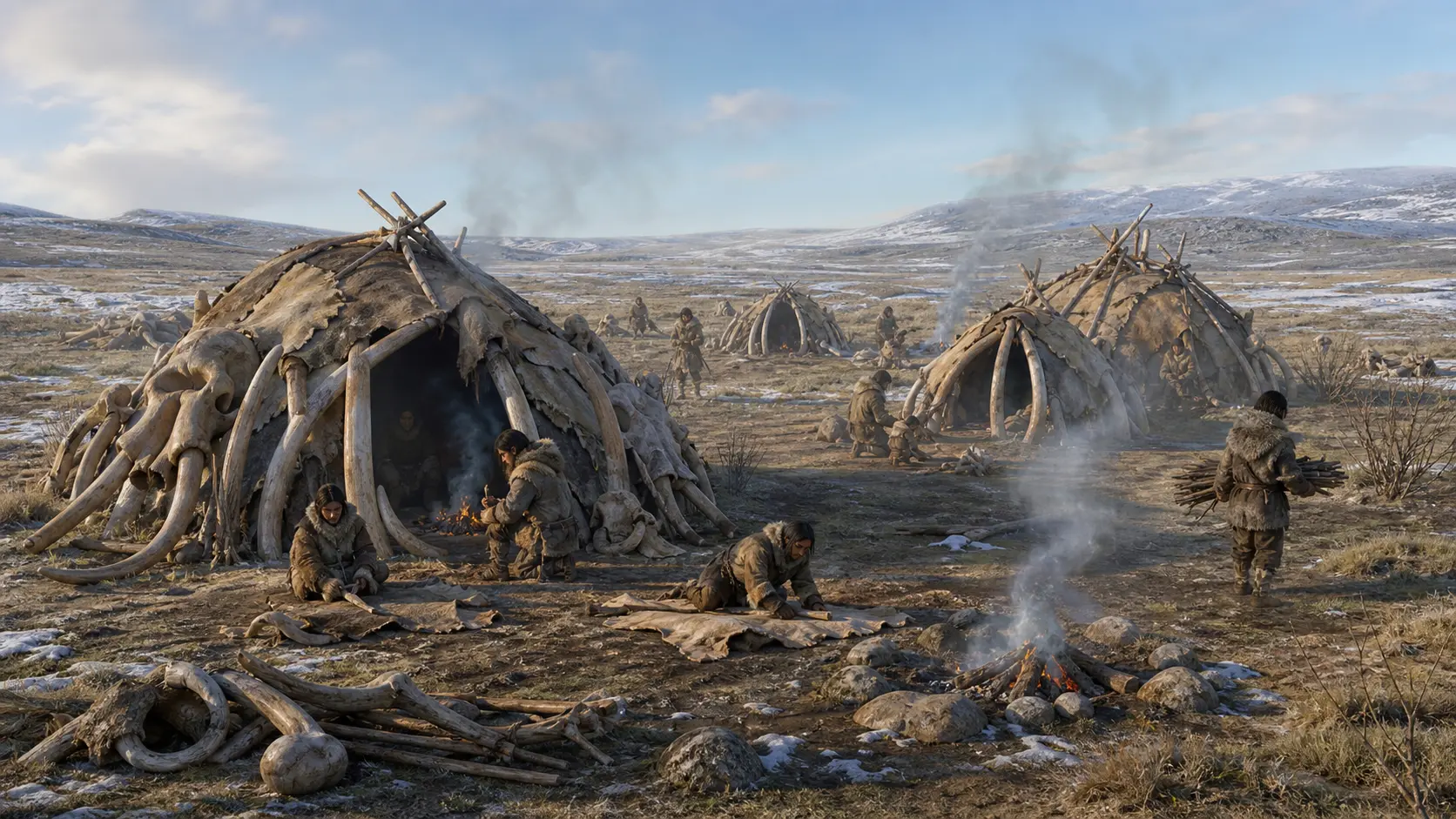
Archaeologists usually treat Kostenki-Borshchevo as a complex rather than a single camp. Some occupations are very early in the Upper Paleolithic, while others belong to later Gravettian and post-Gravettian traditions. Evidence from individual sites and occupation layers must therefore be distinguished from broader Upper Paleolithic reconstruction. The account below draws on mammoth-bone structures, hearths, tools, burials, and ornaments from different contexts, alongside possible reconstructions of shelter use, meals, and social routines. These features and activities were not necessarily contemporary or documented at every camp; Kostenki 11, for example, cannot stand for the whole complex.
Housing and Living Spaces
Shelter needs at Kostenki would have varied with weather, terrain, and the length of an occupation. Some camps may have been short visits for hunting, tool repair, or butchery, while others left dense deposits of ash, stone debris, animal bone, ochre, and ornaments. Mammoth-bone concentrations and deliberately arranged structures are important evidence, especially the circular structure at Kostenki 11 discussed by Pryor et al. in the references below. A concentration of bones is not automatically a building, however, and a bone circle does not by itself establish a roofed dwelling. Bones could have served as weights, supports, windbreaks, or boundaries. Roofing with hides, wood, brush, turf, or earth remains an interpretation that requires evidence from the particular structure.
Hearths and distributions of tools, bone, and working debris provide evidence for activities in and around camp spaces. Fires could supply warmth, light, and heat for cooking or drying, but their presence does not establish every use or the social routines around them. Flint knapping, hide work, and animal processing may help explain some activity areas where the associated traces support those interpretations. Sleeping or sitting places lined with hides, grasses, or furs are possible reconstructions, not a securely known arrangement for every camp. Likewise, heavy bones, stones, or prepared cores might have been kept for later visits, but their survival on a site does not alone demonstrate planned storage.
The surviving evidence does not provide a complete floor plan of fixed rooms, bedding, drying areas, and food stores. Moving belongings away from smoke or toward light is a plausible response to changing conditions, rather than an observed Kostenki routine. Concentrations of ash, broken bones, and discarded tools may help reconstruct refuse disposal and the reuse of materials, but such interpretations depend on how deposits formed during and between occupations. Particular places may have been revisited, yet the exact layout of a household and the balance between construction, repair, storage, and movement remain questions for each site and layer.
Food and Daily Meals
Animal remains are evidence to interpret, not a direct record of meals. Mammoth bones are especially visible because large bones preserve well and were reused in structures; their abundance does not directly measure how much mammoth people ate. The animals discussed in this account—mammoth, horse, reindeer, bison, hare, fox, birds, and others—should not be read as a menu documented at every Kostenki camp. Their dietary importance requires evidence from individual occupations, including the context and signs of processing on remains. Fish and gathered plant foods may have mattered seasonally, though their role remains uncertain. Roots, berries, seeds, greens, and edible inner bark are possible food categories in a broader reconstruction, not a site-specific list established here. Fat would have been a valuable food resource, but this does not establish routine collection of every form of marrow, grease, or fatty tissue at each site.
Obtaining food from a large carcass could involve skinning, butchery, division, and transport. Which parts were processed at a kill location and which reached camp must be assessed from the remains in each context. Cracking long bones can release marrow, while crushing and heating spongy bone can recover grease; these are possible processing methods, not practices demonstrated here for every Kostenki occupation. Roasting over embers, drying near a hearth, smoking, and stone-boiling in hide, bark, or wooden containers are also possible reconstructions. The supplied evidence does not establish that full range of techniques or container materials at a particular camp, and a hearth alone cannot identify them. Freezing could have aided storage while making cutting, thawing, and transport more difficult.
Meals may have involved household groups or wider sharing after a major kill, but their size, setting, and distribution rules are not established by the evidence presented here. Sharing could have reduced the risks of uneven hunting returns and supported children, elders, injured people, visitors, or craftspeople; this is a possible social reconstruction, not a documented Kostenki allocation system. Animal processing could also supply hides for shelter or clothing, sinew for thread, bone for tools, and teeth for ornaments. These possible connections between food and craft work do not establish a fixed sequence of scraping, drying, sewing, carving, and cleaning after each meal.
Work and Labor
Work in the Kostenki camps was continuous, varied, and highly skilled. Hunting required tracking animals across open ground, reading snow or mud, judging wind, preparing weapons, and deciding when cooperation was worth the risk. Large animals could not be handled casually. Even after a successful encounter, people had to manage knives, scrapers, carrying loads, fire, water, storage, and protection from carnivores. Smaller animals also mattered because they provided food, fur, sinew, and bones for tools. Trapping, snaring, and opportunistic hunting may have supplemented larger hunts, especially when groups needed reliable returns between major events.
Domestic labor kept the camp usable. People gathered wood or other fuel, maintained embers, fetched water or snow, repaired shelter coverings, cleaned hearths, sorted refuse, dried clothing, and watched children near fires and tools. Hide work was one of the most demanding routines. Skins had to be scraped, stretched, softened, smoked, cut, fitted, sewn, and repaired. Shelter covers, bedding, bags, straps, winter garments, and footwear all depended on this labor. Because hides could stiffen, rot, tear, or lose insulation, maintenance was constant. The same task might be practical and social: several people scraping or sewing around a hearth could teach younger members, exchange news, and prepare for movement.
Craft work added another layer of labor. Stone knappers selected flint or chert, prepared cores, struck blades and flakes, retouched edges, and recycled broken pieces. Bone, antler, ivory, and tooth workers made points, awls, needles, smoothers, beads, pendants, and other objects. Some work was done for immediate survival, such as sharpening a cutting edge before butchery. Other work prepared for future needs: a spare needle, a straightened point, a repaired bag, a bundle of bindings, or a set of ornaments for a gathering. Children may have learned by observing and helping others. Carrying fuel, sorting flakes, holding hides, gathering bedding, or practicing on discarded material are possible examples, not specific children's chores established by the Kostenki evidence presented here. Labor at Kostenki was not separated into modern categories of job and home. It was the daily coordination of movement, food, shelter, care, memory, and material skill.
Social Structure
Households, kin ties, partnerships, and wider regional networks offer possible ways to reconstruct Kostenki social life. Several hearth groups might have shared work, food, and information while maintaining separate activity spaces, but hearths alone do not reveal household membership. Visits to relatives, marriage partners, hunting allies, or other groups could have linked camps. Seasonal gatherings and exchanges of stone, ornaments, information, technical knowledge, or help during shortages are possible mechanisms for maintaining those links. Specific marriage networks and gathering routines are not established by the evidence presented here.
Ability, age, generosity, memory, and reliability might have contributed to influence, but these are possible bases of status rather than established Kostenki rules. A skilled hunter, skilled garment maker, experienced knapper, knowledgeable elder, healer, or ornament maker could have been valued for their competence; these examples do not identify documented social offices. Burials and personal ornaments from the broader Kostenki-Borshchevo complex provide material evidence of treatment of the dead and personal adornment. Ochre, beads, pendants, and differences in burial treatment can invite interpretations about identity, memory, relationships, or belonging. Their precise meanings, and any connection to rank or hierarchy, cannot be read directly from the objects or assumed to have been the same across occupations.
Large-animal hunting, construction, garment making, and care could have involved cooperation, although the organization of that work remains uncertain. Mediation, pressure from relatives, temporary separation, or movement to another camp are possible ways mobile groups might have managed conflict, not established Kostenki practices. Ornaments and decorated clothing may have communicated affiliations, but their specific messages are unknown. Knowledge of routes, water sources, useful stone, and old bone concentrations could have been shared between generations. How children learned that knowledge, understood belonging, or acquired obligations is a social reconstruction rather than something the surviving camp remains directly record.
Tools and Technology
Kostenki technology combined portable stone toolkits with extensive organic materials. Stone tools included blades, flakes, scrapers, burins, backed pieces, points, and cutting edges made from prepared cores. Scrapers helped clean hides, burins worked bone or ivory, and sharp flakes handled butchery and plant cutting. Many tools were probably hafted into wood, bone, antler, or ivory handles with sinew, hide strips, resin, or other bindings. Composite tools were efficient for mobile life because a broken insert could be replaced while the handle remained useful.
Organic technology was just as important, even though it survives less often. Bone and antler points, awls, needles, smoothers, wedges, ornaments, and ivory pieces supported hunting, clothing, shelter, and display. Mammoth bone could structure camp space, weigh hides, support windbreaks, or provide raw material. Fire was a core technology for cooking, heating, lighting, drying, thawing, grease extraction, and making a shelter usable in severe weather. The technical system also included skills that left only faint traces: knotting, sewing, hide softening, cordage, carrying bags, bedding, snow management, and the careful control of smoke and heat around a hearth.
Clothing and Materials
Clothing at Kostenki had to protect people from cold, wind, damp ground, and long movement across open terrain. Sewn hides and furs were probably worn in layers, with fitted garments more useful than loose skins alone. A practical clothing set may have included parkas or tunics, leggings, mitts, caps, belts, bags, and soft footwear insulated with grass, fur, or hide. Making these garments required scrapers, awls, needles, sinew thread, hide thongs, and patient fitting. Good seams reduced heat loss, while repair patches extended the life of valuable skins.
Materials came from every part of the environment. Mammoth, horse, reindeer, hare, fox, bird, plant fiber, wood, stone, ochre, ivory, teeth, and shell or other exchanged materials could all enter daily use. Clothing also carried social meaning. Beads, pendants, pigments, pierced teeth, and decorated attachments could be worn on the body or sewn onto garments and bags. A person arriving at a gathering therefore displayed household labor, access to materials, age, affiliation, and personal history. Dress was protection, storage, repair work, and social signal at once. Because garments wore quickly in hard conditions, mending was not occasional. It was part of everyday camp routine, done beside fires with the same attention given to food, tools, and shelter.
Daily life in the Kostenki Upper Paleolithic camps was built around return and movement. People made substantial shelters, reused mammoth bone, tended hearths, processed animals, repaired clothing, shaped stone and bone tools, and maintained social ties across a demanding Ice Age landscape. The archaeological record preserves fragments, but those fragments point to households that were technically skilled, cooperative, and deeply familiar with the Don River places they used again and again.
Related pages
- Daily life in Gravettian mammoth bone villages during the late Ice Age
- Daily life in Upper Paleolithic Europe (c. 20,000 BCE)
- Daily life at Dolni Vestonice (c. 25,000 BCE)
- Daily life in Aurignacian Europe during the early Upper Paleolithic
References
- Anikovich, M. V., Sinitsyn, A. A., Hoffecker, J. F., Holliday, V. T., Popov, V. V., Lisitsyn, S. N., Forman, S. L., Levkovskaya, G. M., Pospelova, G. A., Kuz'mina, I. E., Burova, N. D., Goldberg, P., Macphail, R. I., Giaccio, B., and Praslov, N. D. (2007). Early Upper Paleolithic in Eastern Europe and implications for the dispersal of modern humans. Science. https://doi.org/10.1126/science.1133376
- Pryor, A. J. E., Beresford-Jones, D. G., Dudin, A. E., Ikonnikova, E. M., Hoffecker, J. F., Gamble, C. S., and Pryor, F. L. (2020). The chronology and function of a new circular mammoth-bone structure at Kostenki 11. Antiquity. https://doi.org/10.15184/aqy.2020.7
- Seguin-Orlando, A., Korneliussen, T. S., Sikora, M., Malaspinas, A. S., Manica, A., Moltke, I., Albrechtsen, A., Ko, A., Margaryan, A., Moiseyev, V., Goebel, T., Westaway, M., Lambert, D., Khartanovich, V., Wall, J. D., Nigst, P. R., Foley, R. A., Lahr, M. M., Nielsen, R., Orlando, L., and Willerslev, E. (2014). Genomic structure in Europeans dating back at least 36,200 years. Science. https://doi.org/10.1126/science.aaa0114